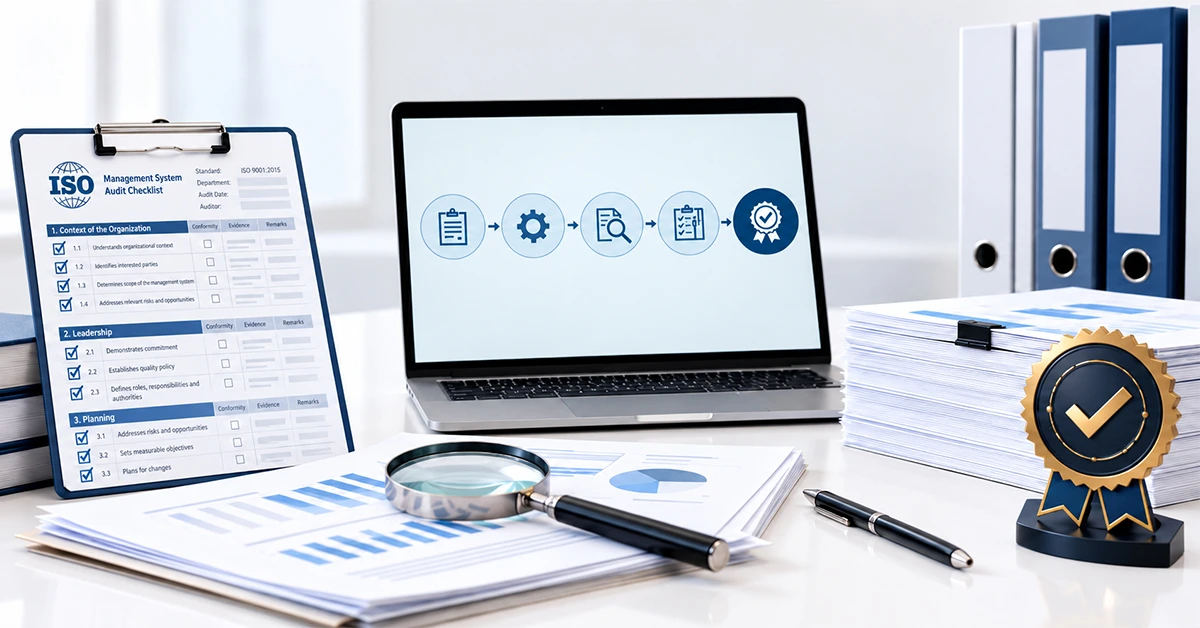
ISO certification can help organisations demonstrate that their management systems follow an internationally recognised framework for quality, information security, environmental management, occupational health and safety, or other areas. For businesses operating in European and US markets, certification may also form part of customer, supplier, tender, or contractual requirements.
However, achieving certification involves more than preparing documents and booking an audit. Organisations need to understand the selected ISO standard, assess their current processes, address identified gaps, implement the management system, conduct internal audits, complete a management review, and prepare for the external certification audit.
The certification process generally moves from preparation and gap assessment through implementation, internal verification, Stage 1 and Stage 2 audits, corrective actions, and the certification decision. The exact requirements and audit arrangements can vary according to the standard, organisation size, scope, industry, and certification scheme.
Key Takeaways
- A gap assessment identifies differences between current practices and the requirements of the selected ISO standard.
- Certification preparation involves implementation, documented information, employee awareness, monitoring, internal auditing, and management review.
- Stage 1 focuses on readiness, scope, documentation, and planning for Stage 2.
- Stage 2 evaluates whether the management system is actually implemented and working in practice.
- Nonconformities may require corrective action and evidence before certification can be completed.
- Businesses targeting European and US customers should consider customer, contractual, industry, and market-specific expectations alongside ISO requirements.
- Certification is not the end of the process because certified organisations normally undergo continuing surveillance and later recertification.
Table of Contents
- Understand the ISO Certification Process
- Select the Right ISO Standard
- Conduct a Gap Assessment
- Develop an ISO Implementation Plan
- Prepare Required Documentation
- Implement the Management System
- Train Employees and Build Awareness
- Conduct Internal Audits
- Complete the Management Review
- Select a Certification Body
- Prepare for the Stage 1 Audit
- Understand the Stage 2 Certification Audit
- Handle Nonconformities and Corrective Actions
- Complete the Certification Decision
- Prepare for Surveillance Audits
- ISO Certification Considerations for European and US Markets
- Common ISO Certification Mistakes to Avoid
- Practical ISO Certification Checklist
- Conclusion
- FAQs
Understand the ISO Certification Process
The ISO certification journey usually involves several connected stages.
A simplified process looks like this:
Gap assessment → Implementation → Internal audit → Management review → Stage 1 → Stage 2 → Corrective actions → Certification decision → Surveillance
The exact process can differ depending on the ISO standard and certification scheme. ISO 9001, ISO 14001, ISO 45001, and ISO/IEC 27001, for example, address different management-system subjects, so the evidence and controls assessed will vary.
The initial certification audit itself is generally conducted in two stages. ISO and IAF auditing guidance describes Stage 1 as a readiness and planning assessment, while Stage 2 evaluates implementation and effectiveness.
Select the Right ISO Standard
The first step is identifying which standard is relevant to the organisation’s objectives.
Common examples include:
- ISO 9001 for quality management
- ISO 14001 for environmental management
- ISO 45001 for occupational health and safety
- ISO/IEC 27001 for information security
- ISO 22000 for food safety management
- ISO 13485 for medical devices
- ISO 50001 for energy management
The choice should be connected to the organisation’s actual business requirements.
For example, a software company serving enterprise customers may investigate information security requirements, while a manufacturing business may have quality, environmental, and occupational health and safety objectives.
Conduct a Gap Assessment
A gap assessment compares the organisation’s existing processes against the requirements of the selected ISO standard.
This is an important preparation stage because businesses may already have many relevant processes in place.
The assessment can identify:
- Existing controls
- Missing procedures
- Weak processes
- Documentation gaps
- Training requirements
- Monitoring gaps
- Compliance issues
- Risk management weaknesses
- Internal audit requirements
- Management review requirements
Create a Gap Action Plan
Once gaps have been identified, convert the findings into an action plan.
| Gap | Required Action | Responsible Person | Target Date | Status |
| Missing procedure | Develop and approve procedure | Process owner | Planned date | Open |
| Incomplete records | Establish record-keeping process | Department manager | Planned date | In progress |
| Training gap | Conduct employee training | HR/Management | Planned date | Open |
| Internal audit gap | Develop audit programme | QMS/Management representative | Planned date | Open |
A practical action plan helps management track progress rather than treating the gap assessment as a one-time report.
Develop an ISO Implementation Plan
After identifying the gaps, the organisation needs a structured implementation plan.
The plan may include:
- Management responsibilities
- Process owners
- Policies
- Objectives
- Risk assessment
- Operational controls
- Documentation
- Employee training
- Monitoring
- Internal audits
- Management review
- Corrective actions
Implementation should focus on making the management system part of normal business operations.
Creating documents without actually changing or controlling relevant processes is unlikely to provide sufficient evidence during the certification audit.
Prepare Required Documentation
The documentation required depends on the ISO standard and the organisation’s processes.
Depending on the standard, documented information may include:
- Policies
- Objectives
- Procedures
- Process information
- Risk assessments
- Registers
- Work instructions
- Records
- Monitoring results
- Training records
- Internal audit results
- Management review records
- Corrective action records
The objective should be useful and controlled documentation rather than creating unnecessary paperwork.
Implement the Management System
The next stage is putting the planned processes into practice.
Employees should understand:
- What their responsibilities are
- Which processes they need to follow
- Which records they need to maintain
- What risks apply to their activities
- How problems are reported
- How corrective actions are handled
- How performance is monitored
The organisation should also collect objective evidence that the system is operating.
For example, this may include completed records, monitoring results, training evidence, audit reports, customer feedback, incident records, risk assessments, or corrective actions.
Train Employees and Build Awareness
ISO certification is not only a management responsibility.
Employees who perform activities within the certification scope should understand the relevant requirements and their responsibilities.
Training and awareness activities may cover:
- ISO requirements
- Company policies
- Operational procedures
- Quality or security responsibilities
- Risk controls
- Health and safety requirements
- Environmental responsibilities
- Reporting procedures
- Corrective actions
Training records should be maintained where required by the organisation’s management system.
Conduct Internal Audits
Before the certification body conducts its external audit, the organisation should assess its own management system through internal audits.
Internal audits can help determine whether:
- Processes meet the applicable requirements
- Procedures are being followed
- Records are maintained
- Controls are working
- Employees understand their responsibilities
- Nonconformities are being identified
- Corrective actions are effective
Internal audits should cover the relevant scope rather than focusing only on the areas management expects to perform well.
Complete the Management Review
Top management should review the management system and its performance before certification.
Depending on the standard, the review may consider:
- Audit results
- Customer feedback
- Performance against objectives
- Process performance
- Nonconformities
- Corrective actions
- Risks and opportunities
- Resource requirements
- Changes affecting the organisation
- Opportunities for improvement
This helps demonstrate that the management system is being actively managed rather than treated as an isolated compliance project.
Select a Certification Body
The organisation then needs to select a certification body suitable for the required certification.
When comparing certification bodies, consider:
- Relevant accreditation
- Industry experience
- Geographic coverage
- Auditor competence
- Certification scope
- Audit approach
- Availability
- Audit fees
- Reporting arrangements
For businesses targeting European or US customers, it can be useful to confirm whether the certification body’s accreditation and certificate are recognised or accepted by relevant customers, regulators, tendering organisations, or contractual partners.
Prepare for the Stage 1 Audit
Stage 1 is primarily a readiness and planning assessment.
According to ISO/IAF auditing guidance, the auditor uses Stage 1 to understand the organisation, its management system, scope, processes, locations, relevant legal or regulatory considerations, and readiness for Stage 2.
The auditor may review:
- Management system documentation
- Certification scope
- Locations
- Key processes
- Objectives
- Risks
- Regulatory considerations
- Internal audit arrangements
- Management review
- Implementation status
Stage 1 can identify areas that need attention before the Stage 2 audit.
Understand the Stage 2 Certification Audit
Stage 2 is the main certification assessment.
While Stage 1 focuses on readiness, Stage 2 evaluates whether the management system is implemented and operating effectively.
Auditors may:
- Interview employees
- Review records
- Observe activities
- Examine processes
- Sample transactions
- Review performance data
- Assess controls
- Trace processes from beginning to end
- Compare actual practices with documented requirements
The purpose is to gather objective evidence that the management system meets the applicable requirements within the defined certification scope.
Handle Nonconformities and Corrective Actions
Auditors may identify nonconformities during the certification audit.
The organisation may need to:
- Understand the finding.
- Identify the root cause where appropriate.
- Define corrective action.
- Implement the action.
- Provide objective evidence.
- Allow the certification body to review the response where required.
The treatment of findings depends on their nature and the applicable certification requirements.
A well-managed corrective action process should address the underlying cause rather than simply fixing the immediate symptom.
Complete the Certification Decision
After the audit and required corrective-action activities have been completed, the certification body conducts its certification decision process.
The auditor does not simply hand over a certificate at the end of the audit. Certification involves review of the audit results and the applicable certification requirements.
If the certification requirements are met, the certification body issues the certificate for the defined scope.
Certification is normally maintained through continuing surveillance activities, followed by recertification according to the applicable certification cycle.
Prepare for Surveillance Audits
Certification should not be treated as the final step.
Certified organisations need to continue operating and maintaining their management system.
Ongoing activities may include:
- Internal audits
- Management reviews
- Employee training
- Performance monitoring
- Corrective actions
- Risk reviews
- Document updates
- Operational controls
- Continual improvement
Surveillance audits are used to assess continued conformity during the certification cycle. Recertification is conducted at the end of the applicable cycle.
ISO Certification Considerations for European and US Markets
Businesses targeting customers in Europe and the United States should consider how ISO certification fits into their commercial requirements.
The certificate itself may not be the only consideration.
European Market Considerations
Depending on the industry, European customers may ask suppliers to demonstrate:
- Quality management
- Environmental management
- Information security
- Occupational health and safety
- Supply-chain controls
- Industry-specific compliance
Businesses should distinguish between ISO certification and separate legal or regulatory obligations that may apply to products, services, or specific industries.
US Market Considerations
US customers may also include ISO certification in supplier qualification or contractual requirements.
Requirements can vary between:
- Private-sector customers
- Manufacturers
- Technology companies
- Healthcare organisations
- Government contractors
- Defence-related supply chains
- Large enterprise procurement programmes
The specific acceptance requirements should therefore be confirmed with the customer or contracting organisation.
Certification Scope Matters
A certificate only covers the defined scope.
Businesses should make sure the scope accurately reflects the products, services, locations, and activities that customers expect to see covered.
A certificate with an unsuitable scope may not satisfy a particular customer requirement even if the organisation holds ISO certification.
Common ISO Certification Mistakes to Avoid
Treating Gap Assessment as the Whole Certification Process
A gap assessment identifies what needs to change. It does not replace implementation, internal auditing, management review, or the certification audit.
Creating Documents Without Implementation
Auditors look for evidence that the management system operates in practice.
Leaving Internal Audits Until the Last Minute
Internal audits should provide enough time to identify and correct weaknesses before the external certification audit.
Ignoring Employee Awareness
Employees may be interviewed during an audit. They should understand the processes and responsibilities relevant to their work.
Choosing a Certification Body Only on Price
Businesses should also consider accreditation, competence, industry experience, scope, and customer acceptance.
Failing to Define the Certification Scope
An unclear or overly broad scope can create unnecessary complexity and may not meet customer expectations.
Treating Certification as a One-Time Project
The management system needs to continue operating after certification, including ongoing audits, reviews, corrective actions, and improvement activities.
Practical ISO Certification Checklist
| Stage | Key Activities |
| Standard selection | Identify the appropriate ISO standard |
| Gap assessment | Compare current processes with requirements |
| Planning | Assign responsibilities and target dates |
| Documentation | Prepare required documented information |
| Implementation | Put processes and controls into operation |
| Training | Build employee awareness and competence |
| Internal audit | Evaluate system conformity and effectiveness |
| Management review | Review system performance with top management |
| Certification body | Select an appropriate certification body |
| Stage 1 | Complete readiness and documentation assessment |
| Corrective action | Address identified issues |
| Stage 2 | Demonstrate implementation and effectiveness |
| Certification decision | Certification body reviews audit results |
| Surveillance | Maintain the system and prepare for ongoing audits |
Conclusion
The ISO certification process from gap assessment to final audit involves much more than preparing documents for an auditor. Businesses need to assess their current position, implement the required management system, train employees, conduct internal audits, complete management reviews, and demonstrate that processes are working in practice.
For organisations targeting European and US markets, it is also important to understand the expectations of customers, procurement teams, industry sectors, and contractual partners. ISO certification can support supplier qualification and demonstrate structured management practices, but its usefulness depends on having the right standard, scope, implementation, and certification arrangements.
A structured approach can make the certification journey easier to manage and give the organisation time to address weaknesses before the formal certification audit.
FAQs
What is the first step in the ISO certification process?
The first practical step is usually selecting the appropriate ISO standard and conducting a gap assessment to understand how the organisation’s current processes compare with its requirements.
What is the difference between a gap assessment and a Stage 1 audit?
A gap assessment is generally a preparation activity used to identify weaknesses before certification. Stage 1 is the formal first stage of the certification audit and focuses on readiness, scope, documentation, processes, and planning for Stage 2.
What happens during the Stage 2 ISO audit?
During Stage 2, auditors assess whether the management system is implemented and operating effectively. This can involve employee interviews, record reviews, process observation, and examination of objective evidence.
How long does ISO certification take?
There is no single timeline that applies to every organisation. The duration depends on the selected standard, company size, scope, number of locations, existing management-system maturity, available resources, and audit scheduling.
Is ISO certification useful for European and US customers?
It can be relevant when customers, suppliers, tenders, or contracts require or value certification. However, acceptance requirements vary by industry and organisation, so businesses should confirm the specific requirements of their target customers.
Does ISO certification need to be maintained after the certificate is issued?
Yes. Organisations need to continue operating and maintaining the management system and undergo applicable surveillance and later recertification activities.
READ MORE RELATED GUIDES & BLOGS
Explore more educational resources related to ISO certification, management systems, quality management, compliance, business standards, and European and US market requirements.
- How Much Does ISO Certification Cost for a Small Business?
- How to Prepare for an ISO Certification Audit
- What Is an ISO Gap Assessment and When Do You Need One?